Bolo Alert
The Trojan Horse We Built for Convenience

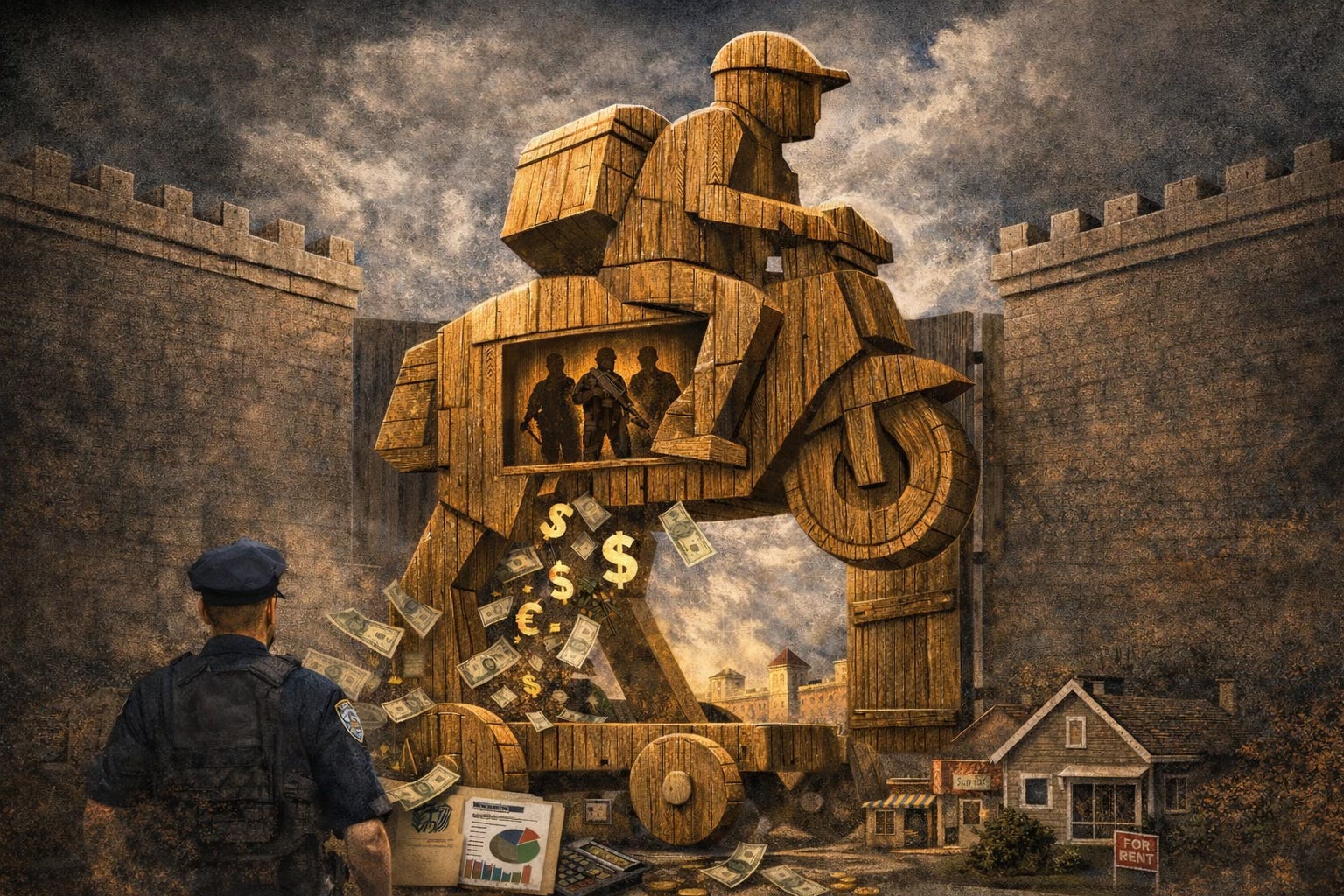
America has a long history of defending itself against external threats. What it has struggled to confront are the threats that arrive quietly, embedded inside systems built for speed, scale, and profit. The modern gig economy may be one of the most consequential examples of this pattern.
Rideshare and delivery platforms now operate as invisible infrastructure. They move through gated communities, apartment buildings, hospitals, schools, and private homes every hour of every day. They are trusted because they are familiar. They are accepted because they are normalized. And they are rarely questioned because they are framed as convenience.
But convenience without verification is not neutral. It is exposure.
These companies maintain that they are technology platforms, not employers. That distinction has allowed them to avoid the level of scrutiny traditionally required of industries that place workers directly into private American spaces. The result is a system where identity verification is inconsistent, enforcement is uneven, and accountability is often fragmented or deferred until after harm occurs.
This is not an immigration debate. It is a systems failure.
When individuals are allowed to earn income under weak or compromised verification standards, the platform does more than facilitate work. It creates an opaque channel for money, movement, and access. That channel does not distinguish between benign use and malicious exploitation. It simply exists.
History shows that systems like this are not attacked head on. They are exploited gradually.
THE FINANCIAL COST TO AMERICA
The first loss is economic and it is measurable.
When large scale labor platforms rely on weak verification, they depress wages by flooding the market with workers who have little leverage and fewer protections. Authorized workers lose bargaining power. Standards erode. The race to the bottom accelerates.
At the same time, the American tax base quietly shrinks.
Income earned through account renting, identity misuse, or unauthorized labor does not reliably contribute payroll taxes, unemployment insurance, or worker compensation funds. Even when some taxes are paid, enforcement gaps mean compliance is inconsistent and often incomplete. The burden shifts from corporations to taxpayers.
Then comes capital flight.
Money earned inside the United States normally circulates. It pays rent. It supports local businesses. It generates sales tax revenue. It strengthens communities through repeated economic exchange.
Remitted money does not do that.
Based on platform reported earnings and conservative participation estimates, it is reasonable to conclude that several billion dollars generated annually through gig economy labor in the United States may be transferred out of the country each year, removing that capital from domestic circulation entirely.
This is not a moral judgment. It is an economic fact.
Finally, there is the cost corporations do not pay.
Weak verification does not eliminate enforcement. It transfers it. Law enforcement agencies, courts, regulators, and intelligence services absorb the cost of investigating incidents tied to unverifiable accounts. Taxpayers fund the response. Corporations issue statements.
This is a hidden subsidy. Profit is privatized. Risk is socialized.
THE THREAT FROM EXTREMIST ENTITIES
The most dangerous consequences are not economic alone.
Money funds influence, propaganda, recruitment, logistics, and conflict. That has been true in every modern war and extremist movement.
The issue is not that most remittances fund extremism. The issue is that when income flows through opaque systems with weak identity controls, there is no reliable way to know when money is diverted toward political violence, religious extremism, or ideological campaigns hostile to American interests.
That uncertainty is the threat.
Extremist entities do not require mass participation. They require gaps. They look for systems where money appears ordinary, movement is normalized, and oversight is minimal. They exploit legitimacy. They hide inside routine.
Delivery and rideshare platforms provide repeated access to civilian infrastructure, geographic familiarity, behavioral patterns, and income streams that appear legitimate on the surface but become difficult to trace once transferred abroad.
This is how infiltration works in the modern era. Not through force, but through invisibility.
The danger is not that every worker is a threat. The danger is that the system cannot reliably identify when one is.
A system that cannot distinguish between benign and malicious behavior at scale is not secure. It is vulnerable.
THE CORPORATE CHOICE THAT MAKES THIS POSSIBLE
None of this is unavoidable.
These companies have the technical capacity to enforce stronger identity verification, recurring compliance checks, and transparent reporting on fraud and account misuse. They choose not to fully implement these safeguards because friction slows growth and reduces margins.
Oversight is treated as optional. Verification is treated as a hurdle. Security is treated as a public relations issue rather than a structural obligation.
That is how Trojan horses are built in the modern age. Not through deception alone, but through normalization.
The greatest threat is not what these systems were designed to do. It is what they allow, and what they continue to allow, because correcting it would be expensive.
History will not ask whether the warning was comfortable. It will ask why the risk was visible and still ignored.